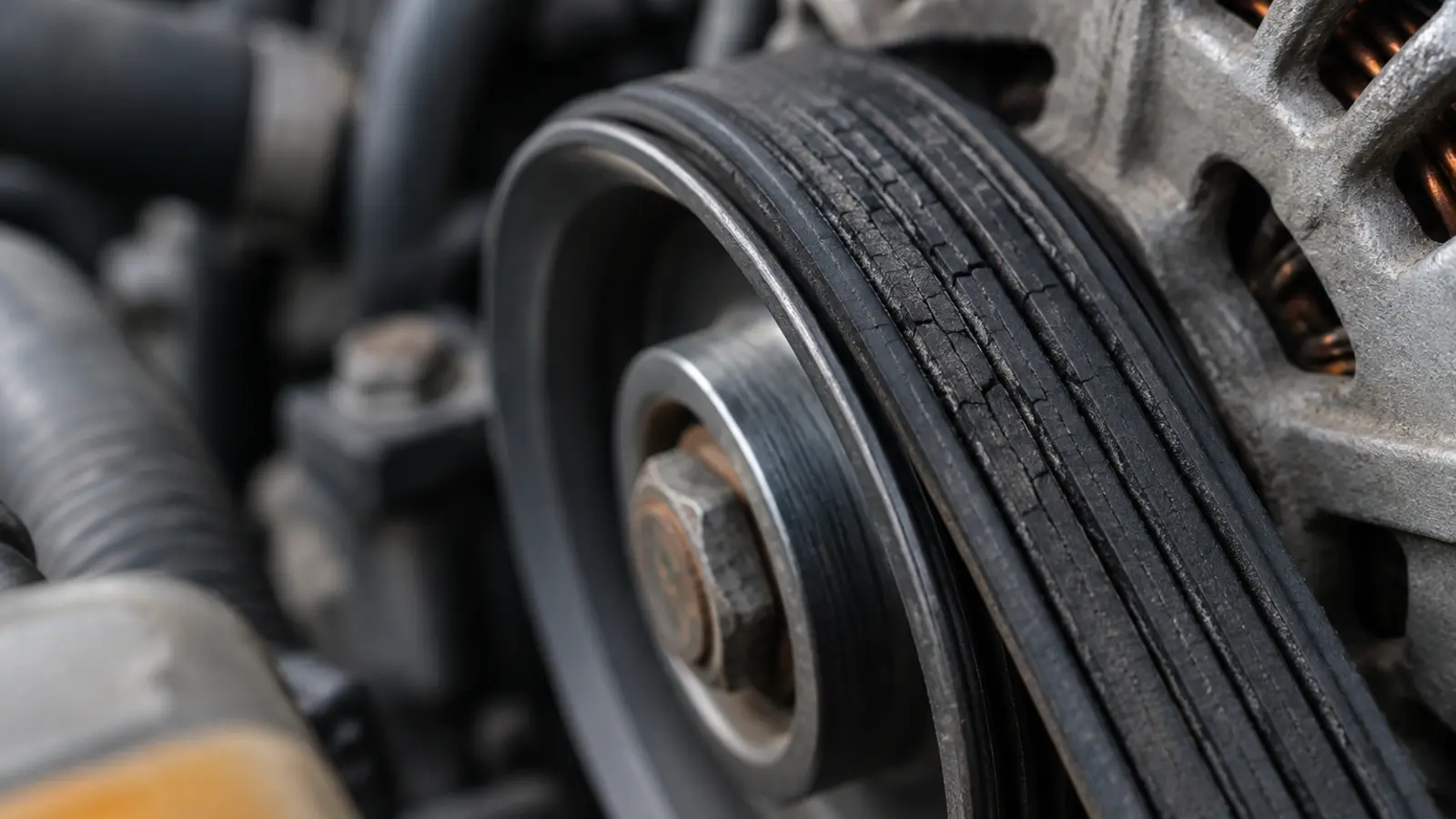
Somewhere under the bonnet of almost every petrol and diesel car is a rubber belt that drives the alternator, the water pump on many engines, the power-steering pump on older ones and the air-conditioning compressor. It costs less than a tank of fuel, it is inspected at every service by a mechanic with a torch, and when it fails the car loses its electrical charge, its cooling and sometimes its steering assistance in the same minute. This guide explains what the belt does, how to tell an auxiliary belt from a timing belt, what a worn belt looks and sounds like, how to check one safely yourself, and what replacement costs in a UK garage.
- A car has up to three belts: the auxiliary (serpentine) belt that drives the accessories, the timing belt or chain that keeps the engine's valves and pistons in step, and on some engines a separate belt for one accessory. Only the auxiliary belt is easy to inspect at home.
- Modern EPDM belts rarely crack. They wear by losing rib depth, so a belt can look fine and be finished. Garages use a plastic wear gauge; a visual check alone is no longer enough on a belt older than about five years.
- Typical UK replacement intervals: auxiliary belt every 60,000 to 100,000 miles or five to seven years; timing belt at the interval in the manufacturer's schedule, commonly four to seven years or 60,000 to 100,000 miles, whichever comes first.
- Typical UK costs in 2026: £60 to £150 for an auxiliary belt fitted, £80 to £250 more if the tensioner is replaced with it, £350 to £800 for a timing belt kit with water pump, and £500 to £1,000 for a belt-in-oil "wet belt".
Which belt is which
The auxiliary belt, also called the serpentine, accessory or drive belt, runs around the outside of the engine over a series of pulleys. It is the one you can see when you open the bonnet: a flat black belt with ribs on the inside face, snaking around the crankshaft pulley, the alternator and whichever accessories the engine has. If it snaps the engine keeps running, but the battery stops charging, the water pump stops on engines that drive it from this belt, and hydraulic power steering goes heavy. Older cars sometimes have two or three separate V-belts doing the same job.
The timing belt, or cambelt, is hidden behind a plastic cover at the end of the engine. It links the crankshaft to the camshafts so that the valves open and close at exactly the right moment. If it snaps on an interference engine, which is most modern engines, the pistons hit the open valves and the repair bill is measured in thousands. Many engines use a timing chain instead, which normally lasts the life of the engine but is not immune to stretch and tensioner faults. You cannot inspect a timing belt without removing covers, which is why it is replaced by age and mileage rather than by condition.
A growing number of small engines sold in the UK since about 2012, including Ford's 1.0 EcoBoost and the 1.2 PureTech used across Peugeot, Citroën, DS, Vauxhall and Toyota models, use a wet belt: a timing belt that runs inside the engine in the oil. These have a specific reputation for shedding material into the oil pick-up when the wrong oil is used or the oil change is stretched, and they need the manufacturer's exact oil grade and, on many of them, a replacement interval that dealers have shortened over time. If you own one, treat the oil change interval as a safety item.
The warning signs of a worn belt
Belts usually announce themselves before they fail. The classic sign is a squeal on a cold start or when the steering is turned to full lock, which means the belt is slipping on a pulley: it may be glazed, loose, misaligned or contaminated with oil. A chirp that comes and goes with engine speed points to misalignment or a worn pulley bearing rather than the belt itself. A rattle or whine from the front of the engine is often the automatic tensioner, whose spring and bearing wear out on a similar schedule to the belt.
The dashboard tells the rest of the story. A battery warning light while driving means the alternator has stopped charging, and a slipped or broken belt is the commonest cause. A rising temperature gauge soon after means the water pump has stopped too. Heavy steering arriving at the same moment confirms it on a car with a hydraulic pump. If all three happen together, pull over as soon as it is safe: an engine without coolant circulation can be damaged within a couple of miles.
Visually, look for cracks across the ribs, fraying at the edges, missing chunks of rib, a shiny glazed surface on the ribbed face, and fine black rubber dust on the surrounding parts. Any of these on an older-style belt means it is due. On a modern EPDM belt, which may show none of them, the test is rib depth: a wear gauge laid across the ribs should sit on the rib tops, not sink into the grooves.
How to check the belt yourself
You need a torch, ten minutes and a cold engine that is switched off with the key out. On a car with keyless start, keep the key well away from the car so nothing can start it while your hands are near the pulleys.
- Find it. Open the bonnet and look at the end of the engine that faces the side of the car (on most transverse engines) or the front (on rear-wheel-drive cars). The belt is the ribbed black loop around the largest pulley.
- Look at the whole length. Use the torch along both faces. Turn the engine over by hand only if you know how to do it safely with a socket on the crankshaft bolt; otherwise inspect what you can see and accept that some of the belt is out of sight.
- Check the tension. On the longest span between two pulleys, press the belt with a finger. Roughly a centimetre of give is normal on a belt with a manual adjuster. Most cars built since the late 1990s have an automatic spring tensioner, and on those the check is the tensioner's own wear indicator, two marks that should sit inside a window; if the pointer is at the end of its range, the belt has stretched.
- Look for the cause, not just the symptom. Oil or coolant on the belt means a leak that will kill the new belt as fast as the old one. A pulley that wobbles when pushed has a failed bearing. Rust or rubber dust in the pulley grooves points to misalignment.
- Listen. With the bonnet open and your hands clear, have someone start the engine while you listen for squeal or chirp at idle, then with the air conditioning switched on, then with the steering turned to full lock.
When to replace, and what it costs
An auxiliary belt is cheap enough that most garages replace it on condition rather than on a fixed schedule, but five to seven years or 60,000 to 100,000 miles is the range most manufacturers quote, and it is sensible to replace the tensioner and any idler pulleys at the same time on a car past 80,000 miles, since the labour overlaps and a seized tensioner will destroy a new belt. Expect to pay between £60 and £150 for the belt fitted, and £80 to £250 more for a tensioner. Independent garages are usually cheaper than franchised dealers for this job, and the part quality is not where the difference lies: a Gates, Continental or Dayco belt is what most of them fit anyway.
The timing belt is a different decision. It is replaced by the manufacturer's interval, which is printed in the service schedule and usually expressed as years or miles, whichever comes first, because rubber ages even in a car that stands still. A timing belt kit that includes the tensioner, idlers and water pump typically costs £350 to £800 fitted in the UK, more on engines where the belt is hard to reach. A wet belt is £500 to £1,000. A timing chain and tensioner, when they do need replacing, is £800 upwards. On a used car with no proof that the belt was ever changed, budget for it as part of the purchase price: it is the single most expensive routine job on the car and the most expensive one to skip.
Belts, the MOT and your insurance
The MOT does not inspect belts. A car with a belt on the point of failure will pass, and a car whose belt fails on the way home will not be covered by anything on the certificate. Nor will your motor insurance pay: mechanical failure and wear are excluded from every UK motor policy, comprehensive or not. What a snapped belt can cause, an accident from sudden loss of steering assistance for instance, is an insurance claim, but the repair to the engine itself is not. The two things that do pay out are breakdown cover, which gets the car to a garage, and a manufacturer or extended warranty, which covers the belt only if the service schedule has been kept. That last point is why a full service history is worth money on a used car: it is the evidence that the belt was replaced when the maker said it should be.
Frequently asked questions
Can I drive with a squealing belt?
For a short distance to a garage, usually yes, but treat it as a warning rather than a noise. Squeal means slip, and a slipping belt is heating up and wearing quickly. If the battery light or the temperature gauge joins in, stop.
How long does a belt last after it starts cracking?
There is no safe answer, which is why cracks are a replacement trigger rather than a countdown. Small cracks across the ribs on an older belt can last months; a belt with cracks that reach the cord, chunks missing or fraying can fail the same day.
Is the timing belt the same as the fan belt?
No. "Fan belt" is the old name for the auxiliary belt, from the days when it drove the radiator fan. The timing belt is a separate, hidden belt that synchronises the engine's valves, and it has its own replacement interval and a far higher cost of failure.
Do electric cars have drive belts?
Not in the same way. A battery electric car has no auxiliary belt because its accessories are driven electrically, and no timing belt because the motor has no valves. A few hybrids keep a belt for the petrol engine, so check the handbook.
Should I replace the water pump with the timing belt?
If the pump is driven by the timing belt, almost always yes. The labour to reach it is the same and a pump that fails later means paying for the whole job twice. Most timing belt kits sold in the UK include it for that reason.